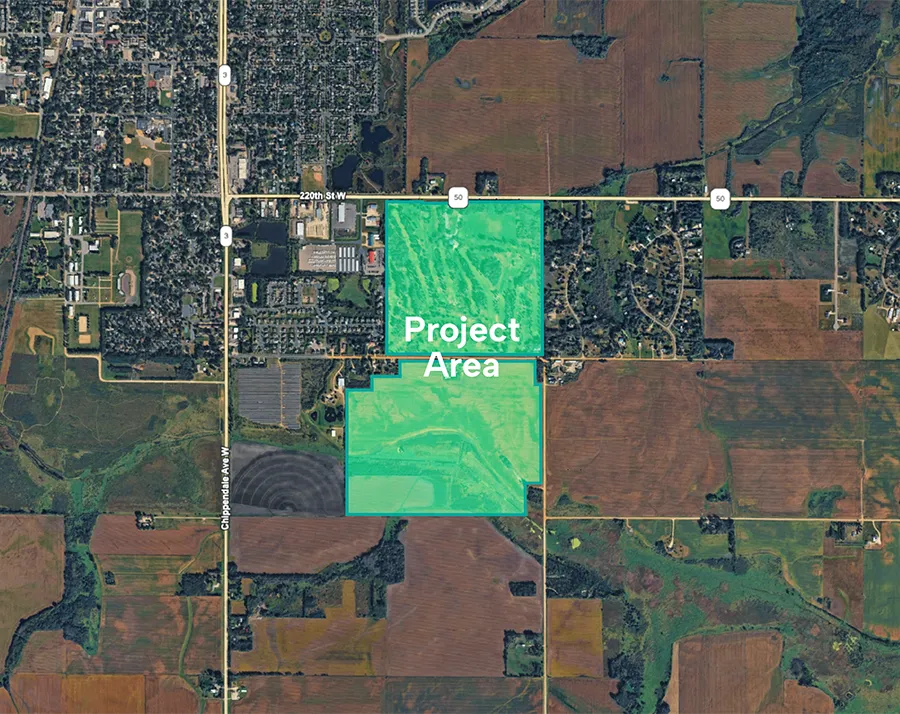
Farmington Technology Park
The Farmington Technology Park will host digital infrastructure for technology companies, while helping to advance the City’s 2040+ Comprehensive Plan and improve local quality of life. The project will bring new jobs, tax revenue, and infrastructure improvements to the community. It will also provide funding to upgrade the power grid with new renewable power sources, while using less water than a new residential development.
Tract is dedicated to working with the Farmington community to address any concerns and explain the benefits of this project before construction begins. This website will continue to be updated with details about the project and provide a forum for us to connect directly.
Project Benefits
The Technology Park is supported by local elected officials and our local utility companies because it represents a significant private investment in Farmington, including:
- 275+ permanent, high-quality skilled jobs, with union support
- Expected future stabilization in home property taxes, due to $18M in new funding for public schools
- Significant new funding for public safety, infrastructure, parks, and more
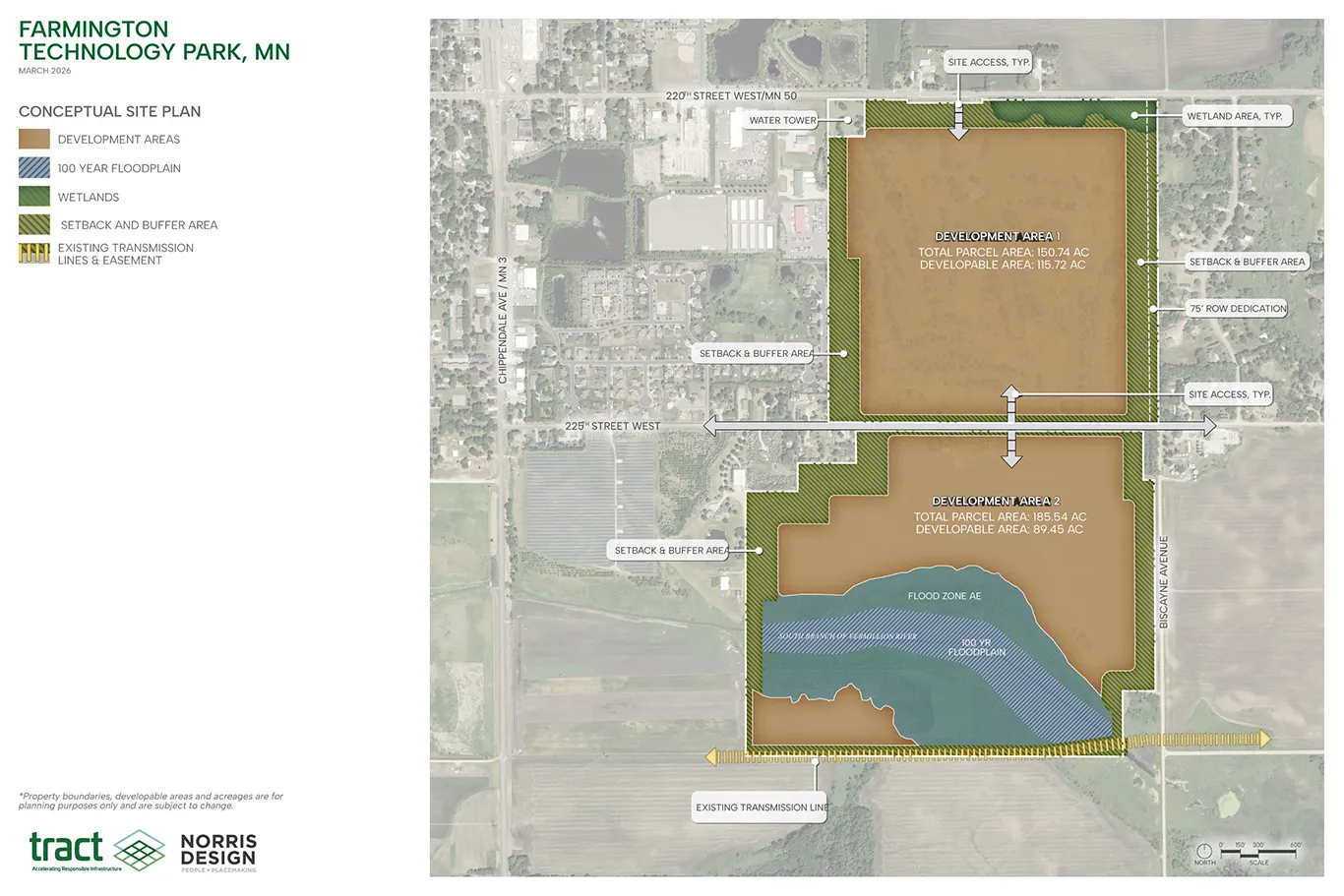
- 11.50 acres dedicated back to the City for future improvements including a public water tower
Job Creation
The Technology Park will generate approximately 275 new, high-quality jobs, which can all be filled by Farmington area residents.
- Construction will require a variety of specialized trades including electricians, network engineers, utility contractors, plumbers, steel workers, and myriad other civil trades. Most of these positions can be filled by local and regional workers, including residents of the Farmington area and Castle Rock.
- Once built, ongoing, permanent, skilled labor will be needed including security, IT technicians, HVAC technicians, electricians, engineers, and more. Many of these are high-salary (averaging around $120,000 annually), skilled jobs — long-term, year-round positions in a growing sector.
- There will be other ancillary jobs related to the ongoing maintenance of the facility, such as landscaping, painting, repair, etc.
Property Tax and Real Estate Value Stability
Significantly increasing local commercial tax bases
- This project will add a large new source of commercial tax base in the City of Farmington, Dakota County, and the Farmington School District, while placing relatively low demands on municipal services, meaning substantial new revenue with minimal added cost.
- If nothing else changes and the campus is built out over the next 10 years, the additional tax base is expected to stabilize or even reduce overall city property taxes, instead of allowing them to rise — potentially by thousands of dollars for the average household — without this investment.
Supporting lower property taxes, increased home values, and additional local revenue
- Property taxes pay for the things that often positively impact property values, like increased investments in schools, parks, infrastructure, and recreation.
- A project like the Farmington Technology Park helps shift more of that cost onto a high-value commercial taxpayer and away from homeowners — while sustaining and improving the schools, safety, and amenities buyers look for when they decide what a home is worth.
- Broad evidence also shows that data centers do not impact home values negatively. In fact, homes farther from data centers tended to sell for less, not more.
- A nationwide review of ZIP codes with large data center campuses found about two-thirds kept up with or beat their state’s 5-year home-price appreciation, with only 1 of 130 ZIP codes showing negative growth.
- For full details on the data, and data analysis, read the white paper, “Data Centers and Residential Property Values.”
The bottom line
- More revenue to fund schools and services that support higher home values
- No systemic evidence that data centers depress nearby home values
Additional Resources for the School District
- With the future purchase of the Farmington Public Schools property, $18 million in additional funding will be paid to the school district, amounting to roughly $3,000 per student.
- The Technology Park is anticipated to generate $75 million in additional tax revenue for the school district over a period of 20 years.
Local Tax Generation
Development requires significant capital investment from the private sector for buildings and infrastructure, construction, equipment, and ongoing operational expenses. With this level of investment, millions of dollars from tax revenue will be generated each year that can support public safety, infrastructure upgrades, parks improvements, schools, and more.
Project Approvals and Completed Work
Tract has been working closely with the City of Farmington, Metropolitan Council, and regional utility regulators who are making the public land-use and infrastructure decisions that govern the project.
The project is subject to layered oversight throughout the development process, including city approvals, state and local permitting requirements, MPCA stormwater and noise standards, Dakota Electric and Great River Energy interconnection studies, as well as additional studies for power and generator needs.
The Farmington Technology Park received major approvals between November 2024 and March 2025 and is moving into the site preparation phase.
November 2024
The City Council approved three important regulatory oversight milestones.
- The Final Alternative Urban Areawide Review (AUAR) was adopted by City Council. This means that the project’s environmental review indicates that the project could move forward with required protections in place.
- The Preliminary Plat, Rezoning application to Mixed Use Commercial/Industrial (MUCI), and 2040 Comprehensive Plan amendment was approved by City Council. This means that the project’s approved layout rezoned the land for commercial and industrial use and updated the City’s long-term development plan to allow the project to move forward.
- The Final Plat and Planned Unit Development (PUD) was approved and adopted by City Council. This means that the final site plan for how the project would be laid out and developed was approved.
December 2024
The official Development Agreement for how the project will move forward with the City of Farmington was approved by City Council.
May 2025
Metropolitan Council approved the City’s updated long-term plan to include the project (in its Comprehensive Plan Amendment on May 14, 2025).
March 2026 – April 2026
- Tract completed soil and groundwater testing required under approved plans and state/county standards to better understand site conditions before future construction work.
- Consistent with the approval Final Plat, as well as Minnesota Department of Health (MDH) and Dakota County standards, Tract conducted onsite work to install soil boring and temporary groundwater monitoring wells to better understand the soil characteristics and the conditions of shallow ground water.
Project Updates
May 2026 – June 2026
Consistent with the approved Demolition Permit from the City of Farmington and Minnesota Pollution Control Agency guidelines, Tract plans to remove the existing clubhouse, associated ancillary buildings, and the shed on the property. located at the southeast corner of the property.
Dead or unsafe trees that are deemed a public safety hazard by the City may also be removed from the property after all the required bird and nesting surveys have been completed.
June 2026 – July 2026:
Tract will work with Minnesota Department of Agriculture through its Voluntary Investigation and Cleanup (AgVIC) program to address environmental conditions resulting from years of operation as a golf course and develop appropriate cleanup steps.
July 2026 – August 2026
Consistent with a Remedial Action Report and Corrective Action Plan, conduct soil excavation and necessary cleanup procedures to address environmental conditions resulting from years of operation as a golf course
To begin in 2026
As part of Tract’s commitment to partnering closely with the Farmington Community, Tract is planning to install landscape berms, a natural-looking buffer that includes tree plantings along the west and east sides of the property, to provide noise and visual mitigation prior to any construction activities.
To begin in 2027
Tract will continue its work to create a landscape to appeal to community needs while also preparing the property for future investment. This includes on-site grading, berming, and general landscaping
To begin in 2028
Consistent with Development Agreement, the City of Farmington will complete its infrastructure improvements in the area which include traffic improvements such as installing traffic lights, drawing turn lanes and creating acceleration and deceleration lanes.
Learn more here about the approval process and development timeline for the Farmington Technology Park.
Project Status
The Farmington Technology Park has received all its major planning and entitlement approvals, and is moving into the site-preparation phase.
Previous Approvals:
- The Final AUAR for the Technology Park was adopted by City Council on November 4, 2024
- The Preliminary Plat, Rezoning application to Mixed Use Commercial/Industrial (MUCI), and 2040 Comprehensive Plan amendment was approved by City Council on November 4, 2024
- The Final Plat and Planned Unit Development (PUD) was approved and adopted by City Council on November 18, 2024
- The Development Agreement with the City of Farmington was approved by City Council on December 2, 2024
- Met Council approved the Comprehensive Plan Amendment on May 14, 2025
A detailed timeline of the project’s previous approvals can be found on the City’s website here.